
Football jersey mesh panels can improve airflow and reduce perceived weight, but a breathable swatch is not automatically a good production panel. The final decision depends on the mesh opening, yarn construction, stretch recovery, opacity, joining method and the position of the panel in the garment. Buyers should approve the complete panel and seam construction on the actual jersey fabric before committing to bulk material.
This guide explains how to compare mesh options for match shirts, training tops and supporter wear. It focuses on practical sourcing questions, controlled sampling and clear acceptance criteria. It does not assign universal performance values to every mesh, because the same construction can behave differently with different yarns, finishes, colors and seam layouts.
1. Define the Job of Football Jersey Mesh Panels
Start with the garment brief. A hot-weather match shirt may prioritize airflow and low weight, while a training top may need a more stable panel that tolerates frequent washing and repeated stretching. A fanwear shirt may require more coverage and opacity than a performance garment. Write the intended use, body position, color, print route and care instructions into the request for quotation.
Position matters. Underarm and side panels often experience repeated extension and contact with seams. Back or upper-body panels may need a different balance of ventilation, opacity and print appearance. A panel that feels comfortable on a table can become irritating if its edge, seam allowance or joining tape sits against the skin.
Use precise language when comparing samples. “Open mesh” usually describes a visibly larger structure; “micro mesh” can describe a finer structure with more coverage; “stable mesh” describes a construction selected for shape control. These are useful working descriptions, not universal technical classes. Ask each supplier for composition, construction, finished weight and usable width rather than comparing names alone.
2. Compare Mesh Structures, Coverage and Joining Options
The table below is a development shortlist. It helps the buyer define what to inspect, but it should not be treated as a performance guarantee for a particular fabric.
| Mesh option | Typical use case | Approval priority | Supplier question |
|---|---|---|---|
| Open mesh | High-airflow zones in hot-weather teamwear | Comfort, snag resistance, opacity and seam stability | How does the panel behave after joining to the jersey body? |
| Micro mesh | Performance garments needing a balance of coverage and ventilation | Airflow, print appearance, stretch and hand feel | What finished construction and color range are available? |
| Stable mesh | Training or fanwear where shape control is important | Dimensional change, seam waviness and abrasion resistance | What stabilizes the structure, and does it change the hand? |
| Mesh with bonded edge | A clean technical look with reduced visible stitching | Bond flexibility, edge lift, press marks and repairability | Which adhesive and process are qualified for this substrate? |
| Mesh with sewn edge | Programs using established sewing capacity | Stitch extension, puckering, bulk and thread comfort | What stitch and feed controls will be used in production? |
Do not assume that a larger opening always produces a better football jersey. A large opening may increase airflow while reducing coverage, snag resistance or print consistency. A finer structure may offer a smoother appearance while changing moisture movement and hand feel. Compare panels under the same lighting and place printed artwork on each sample when appearance is part of the brief.
Joining also changes the result. Sewing can introduce waviness or a raised thread line, while bonding can create a firmer edge or visible press marks if the adhesive and process are mismatched. Review the panel after joining, stretching and washing. The supplier should provide a section drawing and identify where the seam allowance sits.
3. Test the Finished Panel, Not Only the Fabric Swatch
Send production-representative body fabric and the intended mesh to the supplier. Identify the face side, composition, color, finish and print or dye route. Keep each sample labeled so that results from one color or finish are not silently transferred to another. If the jersey uses sublimation, check whether the mesh is intended to be printed, placed beneath a printed body fabric or kept visually separate.
Measure the panel after conditioning and compare it with a retained reference. Record length, width, stretch direction and visible distortion. A buyer can use the current edition of a recognized textile method, such as an air-permeability or laundering method, when a quantitative result is needed. The laboratory and buyer should agree on specimen preparation, conditioning, test direction and acceptance limits before the test starts.
For practical development, inspect the panel in four states: unjoined, joined, extended and laundered. Look for broken yarns, snags, laddering, seam grin-through, edge lifting, puckering, color change and loss of recovery. Check the transition between mesh and solid jersey because that is where different stretch and thickness can concentrate stress.
Run a small pilot through the same cutting, sewing or bonding route used for production. Confirm that markers, feed settings, needles, thread, pressing tools and operator handling can repeat the approved appearance. A supplier sample made by hand may show what is possible, but a pilot shows what the factory can reproduce.
4. Choose by Use Case and Avoid Common Mistakes
For hot-weather match kits, prioritize airflow and skin comfort, then confirm that the selected opening remains acceptable for coverage and snag resistance. For training kits, give more weight to repeated extension, washing and dimensional stability. For supporter or lifestyle jerseys, prioritize opacity, print appearance and a comfortable edge. The correct panel is the one that meets the garment brief after joining and care, not the one with the most impressive isolated swatch.
Common purchasing mistakes include:
- Choosing by a sample card without testing the actual body fabric and seam.
- Comparing mesh names while ignoring finished weight, width and composition.
- Assuming airflow, moisture movement and comfort are the same measurement.
- Approving a color under one light source without checking production lighting.
- Using a bonded or sewn edge process that the factory has not piloted.
- Accepting a replacement yarn or finish without rechecking appearance and recovery.
Price should be compared per accepted garment, not only per meter. Include usable width, cutting waste, joining time, rejects, testing and any special handling. Ask the supplier to state tolerances and change-notification rules. Reapprove the panel if the yarn, finish, colorant, adhesive, machine or seam construction changes materially.
5. Purchasing Checklist and FAQ
Before issuing a bulk order, keep one approval sheet with the fabric identity, mesh construction, finished weight, usable width, color standard, panel drawing, joining method, inspection points and test plan. Retain the approved sample and the pilot-run sample. This gives purchasing, production and quality teams the same reference when a shipment is inspected.
Do football jersey mesh panels always make a shirt cooler?
No. Mesh can increase air exchange in a selected zone, but the garment result also depends on placement, body fabric, fit, humidity, movement and seam coverage. Judge the finished shirt and the intended use.
Is open mesh better than micro mesh?
Neither is universally better. Open mesh may suit a high-airflow zone, while micro mesh may offer more coverage and a different appearance. Compare both against the same brief and acceptance criteria.
Should mesh panels be sewn or bonded?
Choose the joining method that the design and factory can reproduce. Sewing may provide familiar repair and production control; bonding may support a clean technical appearance. Both require finished-sample and laundering checks.
What should a buyer request from a mesh supplier?
Request composition, finished weight, usable width, stretch direction, recovery information, color options, construction drawings, tolerances, care guidance and sample traceability. Ask how substitutions will be communicated.
How can a buyer reduce risk before bulk production?
Approve a production-representative pilot, inspect the joined panel in extended and laundered states, and set acceptance limits in writing. Keep retained samples and records for later comparison.
Source note: The article uses standard textile sourcing practice and recommends that buyers select the current laboratory methods appropriate to their construction. Any numerical claim should be tied to the named method, specimen preparation and agreed acceptance criteria.
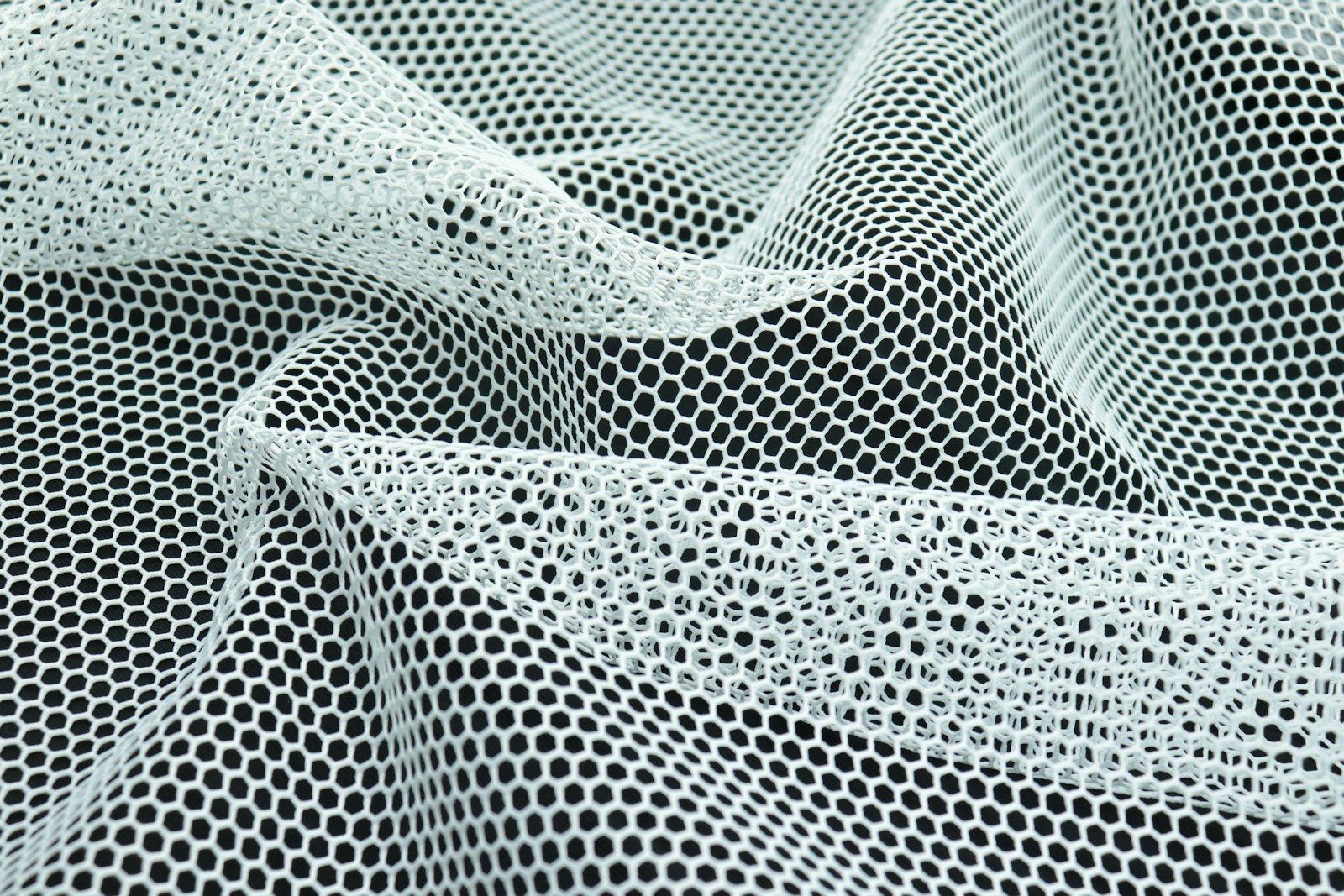
Cover image: “a close up of a black and white mesh,” photographed by Divazus and published on Unsplash. Used under the Unsplash License. The image shows generic mesh fabric and is not a photograph of a football jersey panel.